
Source-led article
Skyroot Vikram-1 Propels India’s Private Space Sector into Orbital Era
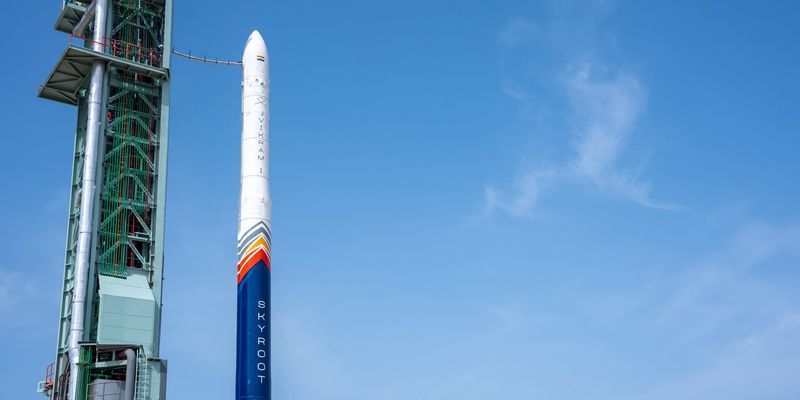
Skyroot Aerospace has achieved a significant milestone with the successful orbital launch of its Vikram-1 rocket under Mission Aagaman. This event marks India’s first privately developed orbital rocket, signaling a new chapter for the nation’s commercial space sector. The achievement validates years of policy reforms aimed at fostering private participation in space activities.
The successful mission demonstrates the capability of Indian private companies to design, build, and operate orbital launch vehicles, a role traditionally dominated by the Indian Space Research Organisation (ISRO). This is seen as a defining moment in India’s space journey, accelerating innovation and opening new frontiers for the private sector.
Policy Reforms and Ecosystem Growth
The launch of Vikram-1 is a direct outcome of the Indian Space Policy 2023, which opened up the entire space value chain—from launch vehicles and satellites to downstream services—to private entities. These reforms, alongside the efforts of the Indian National Space Promotion and Authorisation Centre (IN-SPACe), have cultivated one of the world’s fastest-growing space startup ecosystems. The number of space startups in India has surged from one in 2014 to over 400 by 2026.
Key facts
| Feature | Detail |
|---|---|
| Rocket Name | Vikram-1 |
| Developer | Skyroot Aerospace |
| Mission Name | Mission Aagaman |
| Significance | India’s first privately developed orbital rocket |
| Policy Impact | Validates Indian Space Policy 2023 and IN-SPACe initiatives |
Technical Capabilities of Vikram-1
The Vikram-1 is a four-stage launch vehicle capable of carrying payloads up to 350 kg to Low Earth Orbit (LEO). LEO is a critical region for Earth observation, communication, and scientific satellites. The rocket incorporates advanced features, including an all-carbon composite structure, three solid-fuel stages, and a restartable liquid-fuelled orbit adjustment module. This module, powered by a 3D-printed engine, allows for precise deployment of multiple satellites during a single mission.
Diverse Payloads and Symbolic Gestures
The maiden flight of Vikram-1 carried a combination of commercial, technology demonstration, and symbolic payloads. These included Skyroot’s own SCOPE satellite, a technology demonstration payload from German company DCUBED, Grahaa Space’s SOLARAS S3 satellite, and Cosmoserve Space’s EMBRACE robotic arm demonstrator for future orbital debris removal. Additionally, the mission included symbolic payloads like Cosmic Bloom, a floral-shaped artwork, and a miniature 18-carat gold rocket featuring microscopic sculptures of C. V. Raman, Vikram Sarabhai, and A. P. J. Abdul Kalam, honoring Indian science and space pioneers.
Impact on India’s Space Economy
The success of Vikram-1 is expected to significantly contribute to India’s growing space economy. Valued at approximately $8.4 billion currently, the sector is projected to reach between $40 billion and $45 billion by 2030, with an ambitious target of $100 billion by 2040. This growth is fueled by increasing demand for small satellites for diverse applications such as Earth observation, communications, climate monitoring, and Internet connectivity. Indian startups are now positioned to offer competitive launch services, leveraging lower manufacturing costs and expanding domestic demand.
Broader Ecosystem Developments
The private space ecosystem in India is witnessing rapid expansion beyond Skyroot. Agnikul Cosmos launched its first rocket from a privately operated launch pad in 2024. Other companies like Pixxel, Bellatrix Aerospace, Dhruva Space, and SatSure are enhancing capabilities in Earth observation, propulsion systems, and satellite manufacturing. Technology transfers from ISRO to industry, facilitated by IN-SPACe, are also accelerating, fostering further innovation and collaboration.
While Vikram-1 represents a major achievement, it marks just the beginning of Skyroot’s commercial roadmap and India’s broader ambitions in the global commercial space market.