
Source-led article
GPT-6 Astra completes Portal start to finish without human intervention in under 24 hours
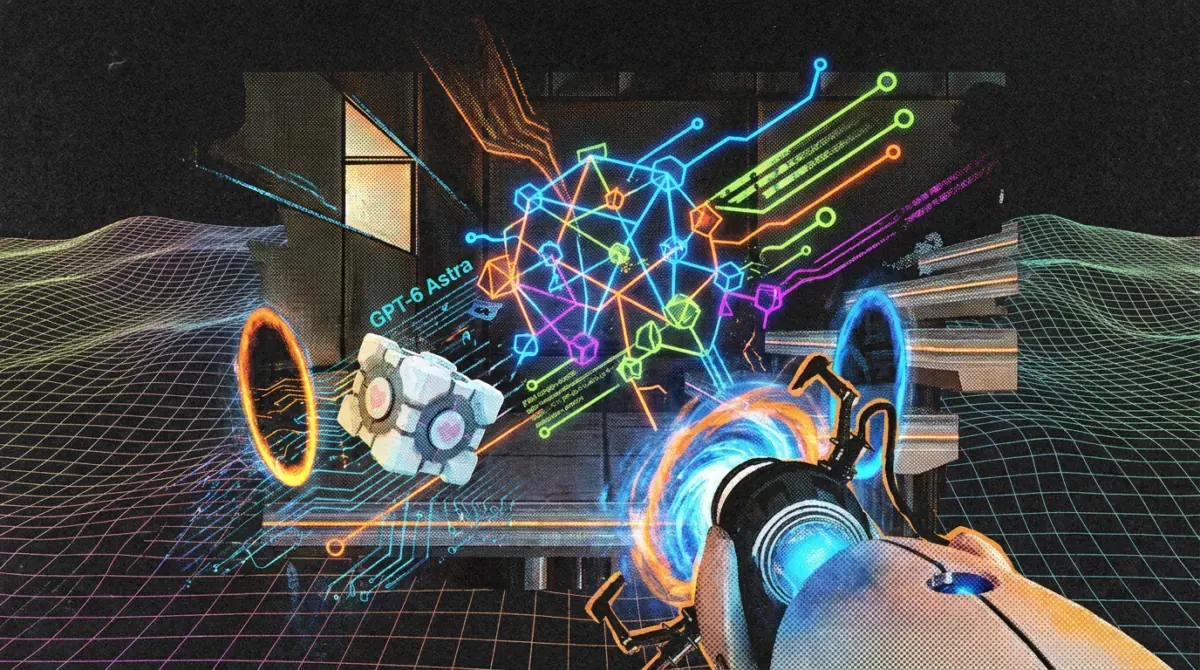
OpenAI’s GPT-6 Astra has demonstrated a significant milestone in autonomous AI gaming by completing the entire puzzle game Portal without any human assistance after the initial objective was set. The run took approximately 23 hours and 43 minutes, with the model navigating through all test chambers and reaching the credits entirely on its own.
Developer cozyblaze, who conducted the experiment, shared the full breakdown on X and published the code and documentation on GitHub. The project showcases how far large language models have come in handling complex, multi-step tasks that require spatial reasoning, planning, and sequential decision-making.
How GPT-6 Astra played Portal
The model controlled Portal through the Model Context Protocol (MCP) and a modified SourcePauseTool, which pauses the game while GPT-6 Astra processes the current state and decides its next actions. During each pause, the agent receives screenshots, player position data, and camera angle information. It then selects inputs—keyboard and mouse commands—before resuming gameplay.
The video shared by cozyblaze has the pauses cut out, so the final footage shows a continuous playthrough. The developer noted that token usage for the entire run would have cost at least $570 at Astra’s list price, though cozyblaze used a $200 Codex subscription to run the experiment.
Datos clave
| Detail | Value |
|---|---|
| Model | OpenAI GPT-6 Astra |
| Game | Portal (full playthrough) |
| Duration | ~23 hours 43 minutes |
| Human intervention | None after initial goal |
| Estimated token cost | $570+ (list price) |
| Infrastructure | $200 Codex subscription |
Code and documentation now on GitHub
Cozyblaze released the full codebase and documentation on GitHub, allowing other developers and researchers to replicate the experiment or build on the approach. The repository includes the MCP integration, SourcePauseTool modifications, and configuration details needed to run GPT-6 Astra with Portal.
This open release is significant for the AI research community in India and globally, as it provides a concrete, reproducible benchmark for evaluating how well frontier models handle complex, real-time environments. Developers working on AI agents, game testing automation, and robotics simulation can study the implementation to understand the model’s decision-making process.
What this means for AI gaming benchmarks
The achievement connects to a long-standing goal OpenAI set in 2016: to build a single agent capable of solving many different games. While earlier attempts focused on reinforcement learning for specific titles like Dota 2 and Atari games, GPT-6 Astra’s Portal run represents a different approach—using a general-purpose language model to understand game mechanics through vision and action selection rather than through game-specific training.
Problems remain, as cozyblaze acknowledged. The model still struggles with certain puzzles that require precise timing or understanding of physics interactions that are not well captured in static screenshots. However, watching an agent beat a full game on its own offers a glimpse of what that original 2016 vision could look like when realised.
Why this matters for Indian AI developers and researchers
For India’s growing AI ecosystem, this experiment demonstrates practical applications of frontier models beyond text generation. Startups working on AI-powered testing, automation, and simulation tools can study the approach to build similar systems for Indian use cases. The open-source release lowers the barrier for Indian developers to experiment with autonomous agents without needing to build infrastructure from scratch.
The token cost of $570 at list price also highlights the current economics of running such experiments, which remains a consideration for researchers and startups operating with constrained budgets. The $200 Codex subscription used by cozyblaze offers a more accessible entry point.
Cozyblaze’s final observation
The developer added a notable remark: GPT-6 Astra is “the worst model we’ll ever get.” This framing suggests that as AI models continue to improve, future versions will likely achieve similar results faster, cheaper, and with fewer errors. The current achievement, while impressive, represents a baseline that will be surpassed by subsequent iterations.
For Indian readers tracking AI progress, this experiment provides a tangible benchmark for measuring how quickly autonomous capabilities are advancing across frontier models.
Source: The Decoder – https://the-decoder.com/gpt-6-astra-beat-portal-start-to-finish-without-human-help-in-under-24-hours/