
Source-led article
National Policy Summit on MedTech Access calls for stronger indigenous innovation and technology adoption in India
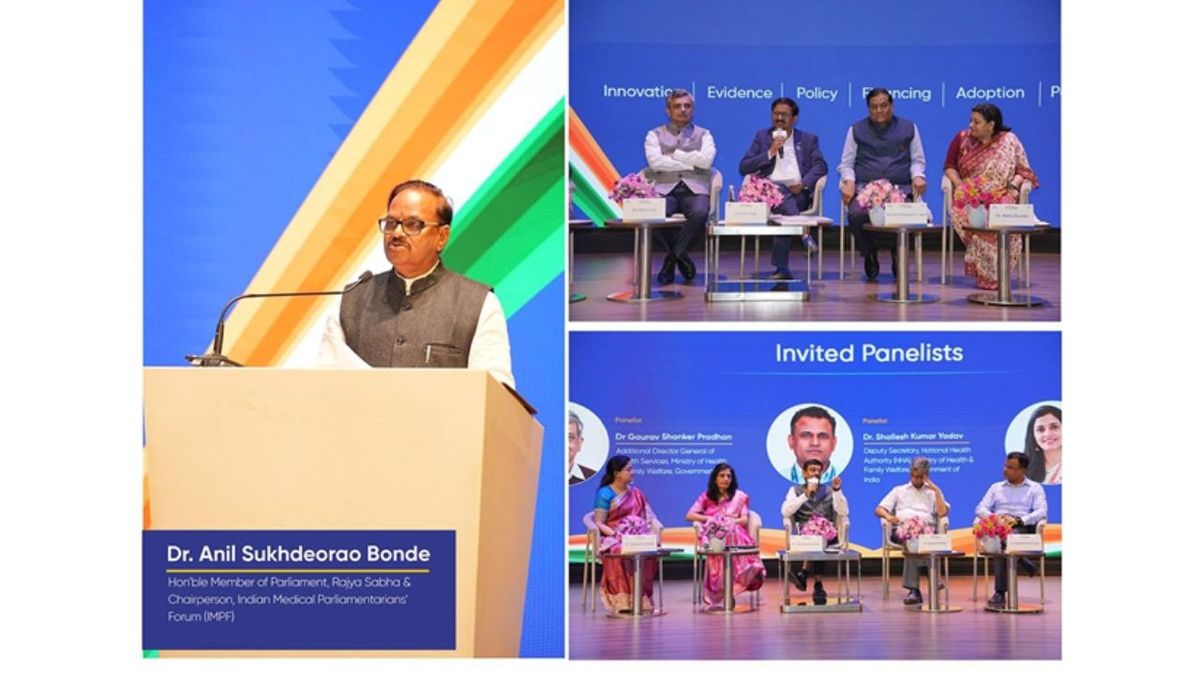
The Indian Medical Parliamentarians’ Forum (IMPF) held its National Policy Summit on MedTech Access on September 22 at Meril Academy in Vapi, Gujarat, under the theme “Swasth Bharat Se Saksham Bharat: Reimagining MedTech Access in India.” The summit brought together Members of Parliament, senior officials from the Department of Pharmaceuticals, Department of Health Research, ICMR, Ministry of Health and Family Welfare, National Health Authority, AIIMS Nagpur and NHSRC, along with clinical experts and industry representatives.
The discussions centred on strengthening India’s medical technology ecosystem, particularly the need for indigenous research and development, robust regulatory and quality frameworks, and clear pathways from innovation to patient access. Two panel sessions examined the enabling environment for a globally competitive medtech sector and the factors that determine whether technology translates into meaningful clinical use.
Building a competitive ecosystem
The first panel, “Building a Sustainable and Globally Competitive MedTech Ecosystem,” was chaired by Dr Shivaji Bandappa Kalge, with Manoj Joshi, Secretary of the Department of Pharmaceuticals, as co-chair. Panellists covered research and innovation, regulatory quality, industry-academia collaboration, domestic manufacturing capabilities, supply-chain resilience and the clinical requirements that Indian medtech companies must address to serve both domestic and global markets.
Dr Anil Sukhdeorao Bonde, MP and chairperson of IMPF, said: “Innovation without access has limited impact, and access without evidence cannot be sustained. For India to build a globally competitive medical technology ecosystem, we need stronger indigenous research and development, credible clinical evidence, appropriate health technology assessment and sustainable reimbursement mechanisms.”
Manoj Kumar Joshi added that self-reliance in medical devices requires a quality- and evidence-based ecosystem, an evolved regulatory system that meets global credibility standards, and strengthened domestic supply chains and component manufacturing. “Building this ecosystem will not only support healthcare access but also contribute to employment and the country’s overall prosperity,” he said.
From innovation to patient access
The second panel, “Expanding Access to Quality Care through MedTech Innovation,” focused on clinical evidence, health technology assessment, financing and reimbursement, technology adoption and workforce capacity. It was chaired by Dr Jashvantsinh Parmar and moderated by Dr Sharmila Sarkar.
Dr Gaurav Shanker Pradhan stressed that a device creates meaningful impact only when healthcare professionals can use it safely and confidently. He called for a shift from equipment-centric to technology adoption models, with competency-based training for clinicians and technicians, and the use of digital learning to extend capacity to underserved areas.
Dr Shailesh Kumar Yadav, Joint Director of the National Health Authority, highlighted the need to link innovation with sustainable financing. He noted that under Ayushman Bharat, newer interventions require credible clinical and economic evidence before inclusion in health benefit packages, and that evaluating the total cost of care rather than upfront device cost is essential for an affordable and sustainable system.
Dr Neha Dumka of NHSRC emphasised that technology for primary healthcare must be assessed for ease of use, cost-effectiveness, scalability and sustainability, not just technical capability. She stressed the importance of ensuring technologies can be effectively adopted at different levels of care.
Dr Prashant P. Joshi of AIIMS Nagpur called for stronger collaboration between medical and engineering institutions, urging joint research, academic programmes and fellowships. He said AIIMS Nagpur is exploring such collaborations with IIT Bombay.
Datos clave
| Element | Detail |
|———|——–|
| Organiser | Indian Medical Parliamentarians’ Forum (IMPF) |
| Date and venue | September 22, 2026 – Meril Academy, Vapi, Gujarat |
| Co-chair (panel 1) | Shri Manoj Kumar Joshi, Secretary, Department of Pharmaceuticals |
| Key themes | Indigenous R&D, regulatory quality, health technology assessment, reimbursement, workforce training |
Impact for Indian tech and digital health
While the summit focused on medical devices and physical technologies, several discussion points directly apply to digital health and AI-driven diagnostics. The emphasis on clinical evidence, health technology assessment and competency-based training mirrors challenges faced by Indian health-tech startups. The call for stronger collaboration between medical and engineering institutions also aligns with the needs of digital health ventures seeking validation and adoption within the public health system.
The source material for this summit is an advertorial on afaqs!, a marketing and advertising news platform. The event’s factual details (attendees, panel themes, quotes) are drawn from that published account. Readers should treat the promotional framing of the source with appropriate caution, while the policy discussions themselves are attributable to named government and institutional speakers.
Source: afaqs! – Indian Medical Parliamentarians’ Forum organises National Policy Summit on ‘Swasth Bharat Se Saksham Bharat’ to reimagine medTech access in India (advertorial)
Datos clave
| Punto | Detalle |
|---|---|
| Fuente | afaqs! |
| Fecha | 2026-09-23T09:50:24+00:00 |
| Tema | Indian Medical Parliamentarians’ Forum organises National Policy Summit on ‘Swasth Bharat Se Saksham Bharat’ to reimagin |