Source-led article
Lendingkart Finance Reports 16% Wider Loss at ₹333 Crore in FY26 as Revenue Plummets 62%
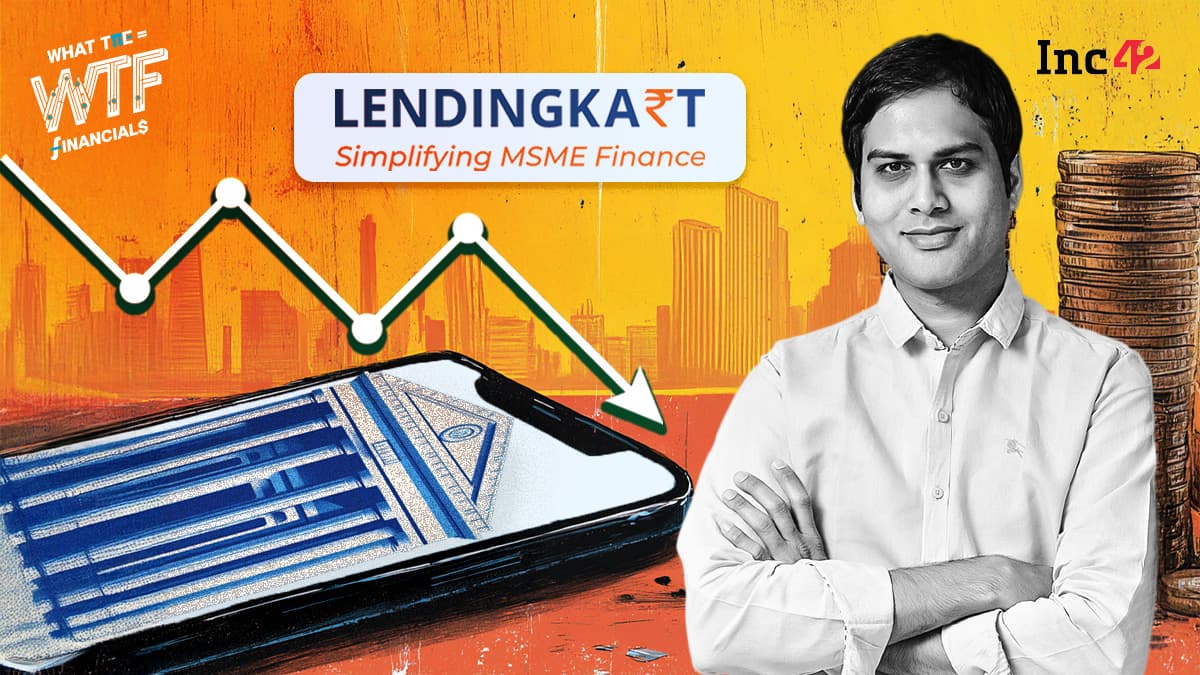
Lendingkart Finance, the non-banking financial company (NBFC) arm of Indian fintech startup Lendingkart, has reported a significant widening of its net loss by 16% year-on-year, reaching ₹333.3 crore in the fiscal year FY26. This comes as the company’s operating revenue plummeted by 62% to ₹327.3 crore, largely attributed to a sharp contraction in loan disbursements and substantially reduced interest and fee income. The financial results indicate a prolonged period of operational challenges for the Ahmedabad-based NBFC, which had briefly reported a net profit in FY23 before slipping back into losses.
Key Financial Declines
The core financial indicators highlight the extent of the downturn. Interest income for FY26 plunged by 73% year-on-year to ₹227 crore, while fees and commission income saw an even steeper decline of 76%, settling at ₹107.6 crore. The company also registered a loss of ₹19 crore in Q4 FY26 under fees and commission income. Adjustments made during Q4 FY26, including ₹34.4 crore of “receivable from co-lenders” and ₹22 crore in “payable towards direct assignment of loans” no longer deemed receivable or payable, further impacted the interest income. Including other income, the total income for FY26 stood at ₹332.4 crore.
Key facts
| Point | Detail |
|---|---|
| Net loss | ₹333.3 crore, reported as 16% wider year on year. |
| Operating revenue | ₹327.3 crore, reported as 62% lower year on year. |
| Total expenses | ₹773.1 crore, down from ₹1,268.3 crore in FY25. |
| Main pressure | Lower loan disbursements and reduced interest and fee income. |
Operational Challenges and Leadership Turmoil
Lendingkart Finance’s operational decline reflects broader pressures within the digital lending sector in India, exacerbated by internal challenges. The NBFC, once a significant player in digital MSME lending, saw its monthly disbursals fall dramatically from a peak of approximately ₹340 crore to about ₹17 crore by August 2024. This operational downturn coincided with significant leadership changes, including the departure of founder Harshvardhan Lunia as managing director of Lendingkart Finance in June 2025, following his earlier exit as CEO of the parent entity.
The leadership reshuffle saw Prashant Joshi, a former DBS Bank executive, take over as CEO. However, internal tensions escalated into a legal dispute in November 2025, with Lunia approaching the NCLT in Ahmedabad. His petition reportedly cited concerns over slowing disbursals, fundraising decisions, and the acquisition of Upwards Fintech under the new Fullerton-led management.
Impact of Regulatory Environment
The challenges faced by Lendingkart Finance are set against the backdrop of a tightening regulatory environment for digital lenders in India. The Reserve Bank of India (RBI) introduced stricter risk-weight norms on unsecured lending in late 2023. These regulations increased capital requirements for NBFCs operating in the unsecured lending segment, impacting business models that rely on such disbursements. This regulatory shift has placed additional pressure on many fintech firms, including Lendingkart Finance, to reassess their lending practices and capital structures.
Cost Management Amidst Revenue Decline
Despite the severe revenue contraction, Lendingkart Finance did manage to reduce its total expenses by approximately 40% to ₹773.1 crore in FY26, down from ₹1,268.3 crore in FY25. This reduction was observed across several key expense categories. Impairment loss on financial instruments, the largest expense head, decreased by 45% to ₹290.1 crore. Finance costs, reflecting borrowing expenses, fell by 39% to ₹185.6 crore, consistent with a reduced loan book. Employee benefit expenses also declined by 30% to ₹116 crore, suggesting potential layoffs or salary restructuring. Fees and commission expenses dropped by 23% to ₹76.2 crore, mirroring the reduced loan origination activity. While these cost-cutting measures were substantial, they were insufficient to offset the rapid decline in revenue, leading to the wider net loss.
Implications for Indian Fintech and MSMEs
The performance of Lendingkart Finance highlights the volatility and challenges within India’s fintech landscape, particularly for companies focused on MSME lending. For Indian startups and MSMEs relying on digital lending platforms for quick access to credit, such financial instability among lenders can lead to tighter credit availability and increased scrutiny of lending terms. This situation underscores the importance for Indian businesses to diversify their funding sources and for fintech innovators to build robust, resilient business models that can navigate both market fluctuations and evolving regulatory frameworks.
Source: Inc42 – https://inc42.com/buzz/lendingkart-finances-loss-widens-16-to-%e2%82%b9333-cr-in-fy26-revenue-falls-62/