
Source-led article
Household Income Exclusions Spotted in Google Performance Max Campaigns
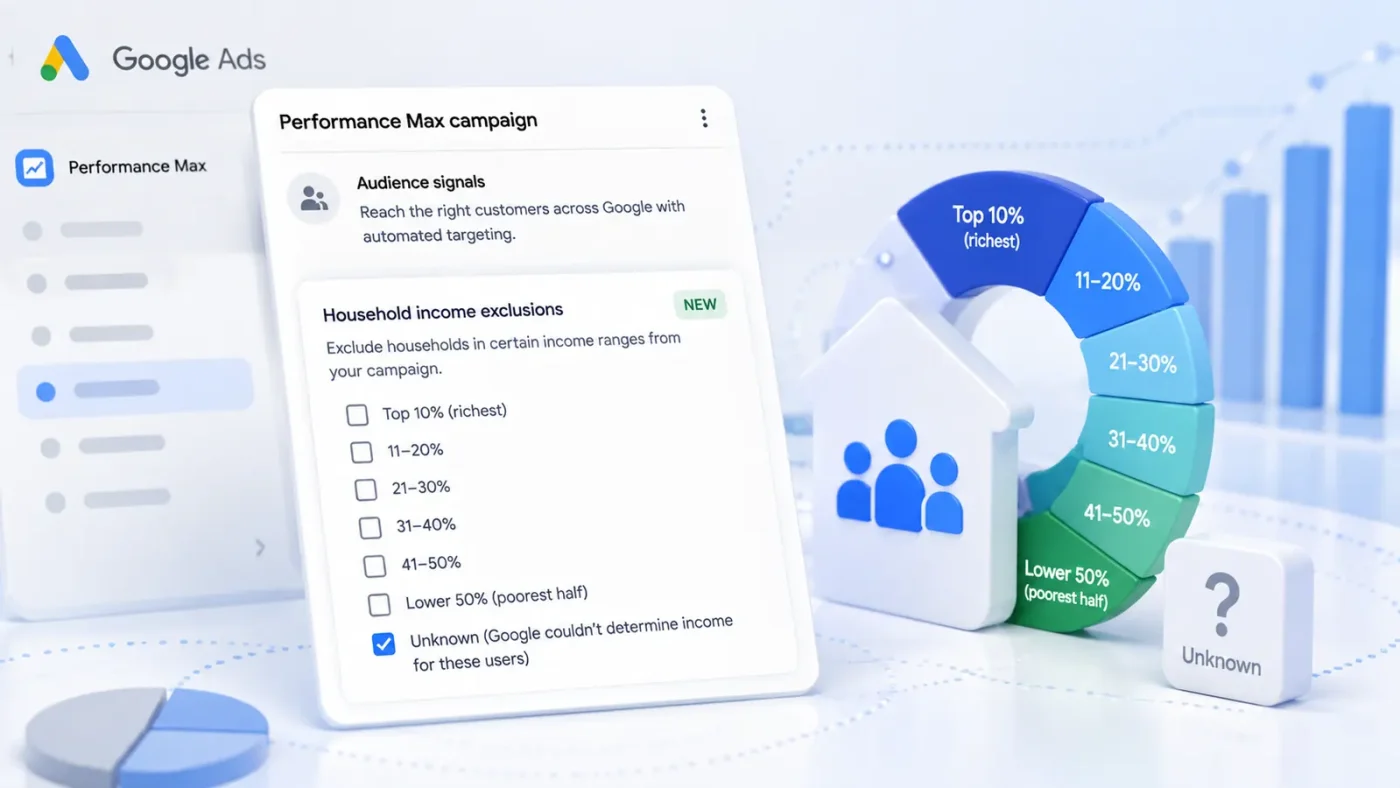
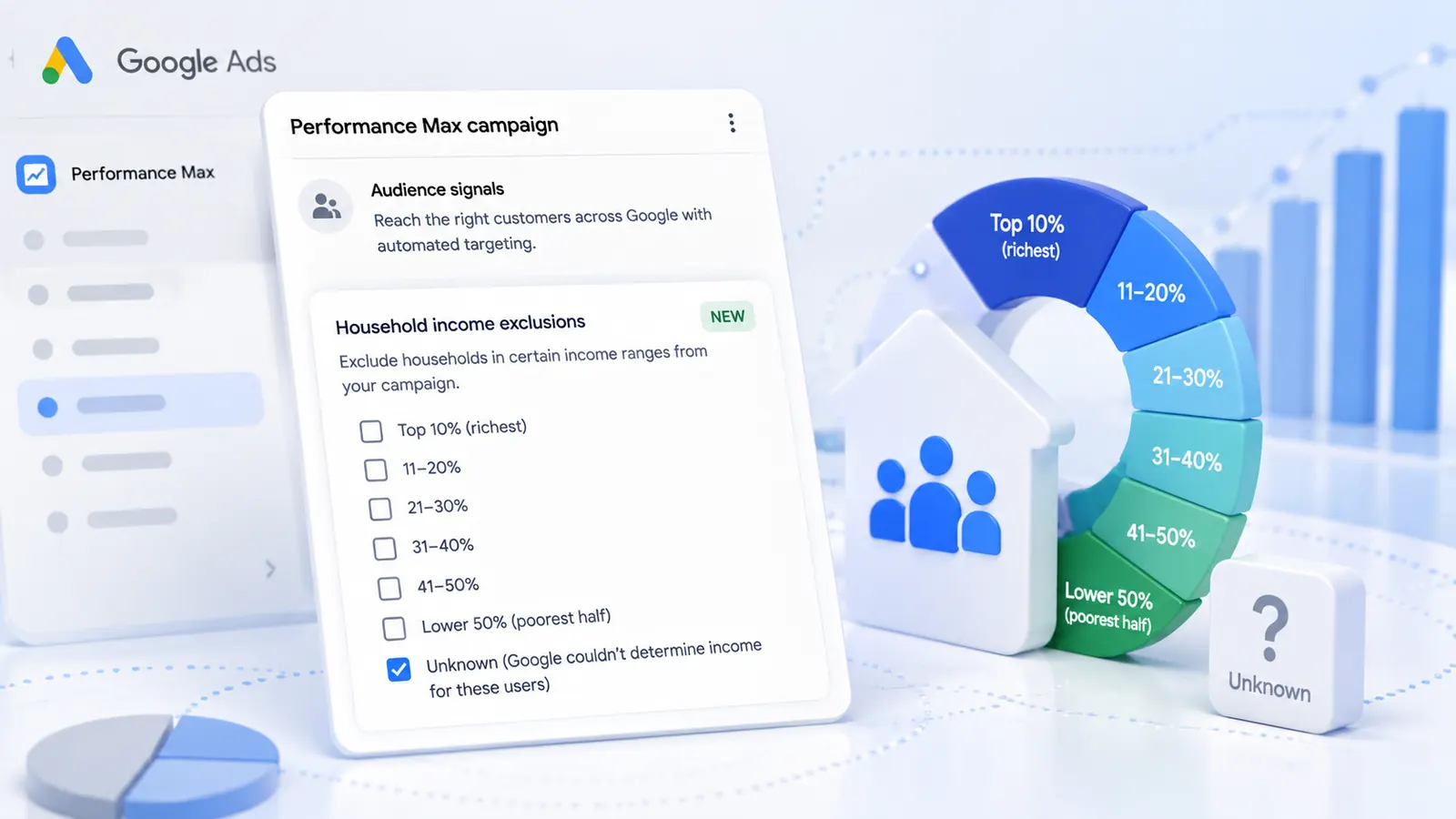
Google appears to be rolling out the ability to exclude specific household income segments from Performance Max campaigns, giving advertisers a level of audience control that has not been available in the automated campaign type before. The new setting was first spotted by paid search expert Thomas Eccel, who shared the discovery on LinkedIn.
The feature, currently visible in a European Performance Max campaign, allows advertisers to exclude users based on Google’s estimated household income. The available exclusion options include the top 10%, 11–20%, 21–30%, 31–40%, 41–50%, and the bottom 50% brackets. Advertisers can select one or more income segments to remove from their campaign targeting directly within the campaign settings.
Why this matters for advertisers
Household income exclusions could help advertisers in industries where income is a strong purchase signal. Luxury goods, premium automotive, financial services, and high-end home services are obvious candidates. By excluding lower-income brackets, these advertisers can better align their campaign delivery with the audience most likely to convert. Conversely, brands targeting value-conscious shoppers, such as discount retailers or budget travel services, could exclude higher-income segments if that fits their strategy.
In India, where income distribution varies widely across metro and non-metro markets, this feature could allow advertisers to fine-tune campaigns for specific customer profiles without resorting to manual bid adjustments or separate campaign setups. For example, a premium automobile brand running a Performance Max campaign for a new luxury model could exclude the bottom 50% of income brackets, ensuring ad spend is concentrated on users with higher purchasing power.
Maintaining AI-driven optimisation
A key concern with Performance Max has always been the lack of granular audience controls. The campaign type relies heavily on Google’s automated bidding and ad placement algorithms, which can sometimes serve ads to less relevant audiences. With household income exclusions, advertisers gain a manual override that does not disable the campaign’s automated optimisation. The AI continues to learn from conversions and user signals, but within a narrower audience boundary defined by the advertiser.
This hybrid approach may appeal to advertisers who want the efficiency of automated campaigns but need to ensure brand safety or budget efficiency. For instance, a financial institution offering high-net-worth wealth management services can now exclude low-income brackets while still allowing Google’s algorithms to optimise for the best-performing placements and creatives.
What remains unconfirmed
The feature has only been spotted in a single European account, and it is not yet clear whether Google plans a global rollout. The company has not made an official announcement. Advertisers should check their own Performance Max campaign settings to see if the option is available. As with any unannounced change, the feature may be in testing and could be modified or withdrawn before a wider release.
Search Engine Land, which first reported the sighting, notes that the exclusion options mirror the same household income segments used in standard Google Display and Video campaigns. This suggests the feature is a natural extension of existing audience controls rather than an entirely new concept.
Key data
| Feature | Description |
|---|---|
| What it does | Allows advertisers to exclude specific household income brackets from Performance Max campaigns |
| Availability | Spotted in a European campaign; not yet officially announced by Google |
| Discovered by | Paid search expert Thomas Eccel, shared on LinkedIn |
What to watch for
If the feature rolls out broadly, it could become one of the more meaningful audience controls added to Performance Max since its launch. Advertisers who rely on income as a buying signal should monitor their campaign settings for the new option. For now, the sighting serves as a reminder that Google continues to iterate on PMax, and advertiser feedback may shape how quickly these controls become standard.
Source: Search Engine Land – Household income exclusions spotted in Performance Max campaigns (https://searchengineland.com/household-income-exclusions-spotted-in-performance-max-campaigns-483494)